Showing posts with label carbon sequestration. Show all posts

23 September 2019

Identifying and Removing Aggressive Invasive Species

This is written for students in Humans and the Environment, a first-year seminar at Monmouth University in central New Jersey, but may be helpful for others working to shift their lawns toward species that support local and migrating pollinators and birds.

Students in class undertake a two-day "ecological restoration project." Part one is removal of invasive species and part two is planting native flowers and shrubs. On day one, we will focus on four different invasive species that have colonized the park.

Japanese Knotweed (native to Japan)
Note the large leaves that alternate along the stem, red bamboo-like stems, and small white flowers. Japanese knotweed flowers in late summer to early fall. In spring and early summer, the leaves are red.

Porcelain berry (native to Siberia)
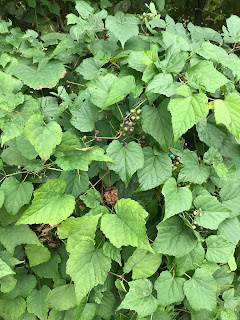
Porcelain berry has five-sided leaves of various forms, long, branching vines, and tough stems. Whitish berries appear in midsummer and ripen to purple and blue. Porcelain berry has long branching taproots that are quite difficult to pull up, especially once established.

Multiflora Rose (native to China, Japan, and Korea)
This is a thin-stemmed bramble with small but tough thorns requiring leather gloves to remove. It has small flowers in mid-summer and small fruits later in the season.

Oriental Bittersweet (native to China)
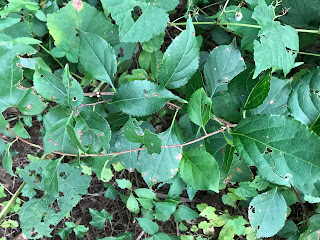
Oriental bittersweet has medium sized, medium green leaves with a pronounced point.
Long, tough vines climb the trunks and branches of trees, blocking sun and choking them out.

Tools and Information

Tools include gloves, pitchforks, shovels, and clippers. For more information about these and other aggressive invasive species, see the New Jersey Department of Environmental Protection Fact Sheet.

All photos courtesy of Catherine N. Duckett, Associate Dean, School of Science, Monmouth University, whose research specialization is evolutionary entomology.

27 June 2019

Humans and the Environment: Syllabus

Dr. Catherine Duckett, Associate Dean, School of Science
Dr. Heide Estes, Professor, Department of English
This course integrates perspectives from literature and biology in investigating contemporary climate issues. Students are challenged to understand the impacts of rising atmospheric and oceanic carbon concentrations in long-term ecological perspectives, to learn about the recent history of climate science debates, and to understand how literature can help to understand the development of current attitudes about environmental issues. Course assignments include a personal environmental project and letters to public officials or news media to encourage students to engage with civic engagement and the ethics of climate decisions.

Readings and Web Sites
Gaines, Susan M. Carbon Dreams. Creative Arts Press, 2001.
Hawken, Paul. Drawdown: The Most Comprehensive Plan Ever Proposed to Reverse Global
Warming. Penguin Books, 2017.
Robert Frost, "A Brook in the City" (1923)
Earth System Science Partnership, Global Carbon Atlas. Global Carbon Project, 2001-2018.
Howard Hughes Medical Institute, EarthViewer app. HHMI Biointeractive, 2012-2017.
Schmittner, Andreas. Introduction to Climate Change. Open Oregon State, no date.
Tallamy, Doug. Bringing Nature Home, 2007. “Why Insects Can’t Eat Alien Plants” and “Blending in
with the Neighbors.”
United Nations report No 2013/3: "Demographic Components of Future Population Growth," K. Andreev, V. Kontorova, J. Bongaarts.
“The Day the Mesozoic Died: The Asteroid that Killed the Dinosaurs.” Howard Hughes Medical
“How do greenhouse gases actually work?” @minuteearth, YouTube
“The Wolves of Yellowstone” BBC Natural World
“Some Animals Are More Equal than Others: Keystone Species and Trophic Cascades” HHMI

Assignments 
Environmental Commitment Project 
Ecological Restoration Project 
Carbon Atlas Project 
Final Project: What Should We Do?

19 May 2019

Flying as an Environmentalist

The amount I’m flying this year is getting me down, because it’s hands-down the most carbon-intensive thing I do, and it negates all the carbon reductions I achieve by eating vegan, biking to work, and trying to reject consumer habits.

I’m flying this year to four conferences to give papers on ecocriticism — the study of how literature and other cultural artifacts like art, movies, and historical documents describe or depict how humans interact with the environment. My scholarly work deals with how the literature of early medieval England represents humans and the environments they occupy and imagine — from wilderness and forests through farms and their homes.

My engagement with medieval ecocriticisms is explicitly activist. I believe that thinking about the ways that humans of the past engaged with their environments can help us understand our present. I also believe that we’re in a time of climate crisis, and ecocritical humanities has to recognize that, and our scholarly endeavors have to advance understanding of the need to act, NOW. So that means I also need to act, myself — and all the flying is a real problem.

The last time I flew, I googled “carbon offsets” for flights, and rapidly went down a rabbit hole of conflicting information. One article claimed individuals don’t need to buy carbon offsets, because airlines are taking care of it. For example, they claimed Delta was providing carbon offsets for all travelers through certain airports, including the one I flew through. Turned out they were only doing that for flights taken on Earth Day.

I decided to create my own carbon sink by planting a tree for every flight I take this year. Here’s number one:


It’s a tiny, baby swamp white oak, maybe a foot tall. I planted it in a gully by Long Branch’s elementary school, with the help of a colleague and friend who has a contact there. In the photo, I’m building a cage made out of hardware cloth that will help protect the little tree from predators, mostly deer, and from accidentally being mowed. I’ll need to check on it periodically, and if we have a dry spell in the next four years I’ll have to water it.

My flights to Detroit, San Francisco, Albuquerque, and Charlottesville will add up to carbon emissions of about 3.4 tons.

A tree can sequester one ton of carbon in 40 years.

I plan to plant four trees this summer to offset the four flights I’m taking. And the labor of doing that is making me think harder about conference planning for next year, because I plan to continue planting trees to offset my own flights. But we’re in climate crisis now — we don’t have 40 years for the trees to grow.