The Guardian has an article this week on reducing one's garbage by "precycling" -- making choices about purchases based on the volume of packaging they come with.
Cutting back on packaging, and in particular packaging that can't be recycled -- is partly about different choices at the supermarket -- some manufacturers use more layers than others, and it's usually possible to buy some of the fruits and vegetables without adding any packaging at all. (You don't actually need to put loose apples or oranges into individual plastic bags for the convenience of the check-out clerks, unless maybe you're buying dozens of each at a time.)
But any serious reduction of waste requires lifestyle change: changes in decisions about what to eat and where to shop. Buying ingredients and cooking at home, rather than buying prepared food, limits packaging. It also extends beyond food: purchases of clothing, kitchen gadgets, home decorations and anything else need to be treated as permanent acquisitions.
The reality is that stuff wears out and has to be replaced. But what's needed is a shift from buying with the idea that things will be discarded soon, to buying with the idea that any given item -- a frying pan, a pair of pants, a candle holder -- is likely to last for a long time, and then caring for stuff to maximize its useful life.
Lifestyle change doesn't have to -- and in fact shouldn't -- be sudden and drastic. The only way to make stuff stick? Change one thing at a time, stick with it until it becomes habit, and then move on to another thing.
Me? I'm still working on reducing plastic packaging. Anybody out there know ... can you buy hair conditioner, or dish soap, in bar rather than liquid form?
Update: Some surfing when I should be working led me to a post over at Life Less Plastic about using Dr. Bronner's bar soap to wash dishes, and to the website of Lush, where you can buy bar conditioner. The Offspring's blond locks need conditioner, so we'll be giving that a try soon. And why didn't I think of good old Dr. Bronner? I've used it for everything while backpacking.
09 June 2011


30 May 2011
Memorial Day
There's not much literature about peace, is there? The Mate, who makes movies and teaches people about writing screenplays, says it's because conflict is what makes a narrative. Some lyric poetry, maybe? It's hard to come up with much.
(There's literature that's not about war, per se, but that's different than literature devoted to peace as a narrative or thematic focus, and often war still lurks in the background, as for instance in characters who bear military titles or the scars of war.)
A lot of people in the United States are remembering the soldiers who have fought and fallen in the US armed forces. Apparently, the holiday began as a day of remembrance for the fighters who fell in the Civil War -- on both sides, and after World War I expanded to include those killed in other wars.
I think it appropriate to remember, today, the dead of all nations. Those who died fighting against the United States, or in wars in which the US had no part, have still left behind shattered families and scarred communities.
(There's literature that's not about war, per se, but that's different than literature devoted to peace as a narrative or thematic focus, and often war still lurks in the background, as for instance in characters who bear military titles or the scars of war.)
A lot of people in the United States are remembering the soldiers who have fought and fallen in the US armed forces. Apparently, the holiday began as a day of remembrance for the fighters who fell in the Civil War -- on both sides, and after World War I expanded to include those killed in other wars.
I think it appropriate to remember, today, the dead of all nations. Those who died fighting against the United States, or in wars in which the US had no part, have still left behind shattered families and scarred communities.
28 May 2011
I Was Curious...
...so I put potato chips, corn chips, and plaintain chips to the test. In the chart below,
 In other words, junk food is junk food. There's no real difference, except for the absence of salt in the plantain chips -- and it's equally possible to buy salted plantain chips. There just don't happen to be any in the house right now.
Thus far, the sugar industry has managed to keep the people who make up these "Nutrition Facts" to define a limit for how much sugar people should consume, which is why there's no percentage of your recommended daily intake following those numbers.
Tomorrow or the next day, more fascinating programming may return. Stay tuned....
K=Kettle Brand Krinkle Cut Potato Chips with Sea Salt
U=Utz White Corn Tortilla Chips
V=Vitarroz Sweet Plantain Chips
 In other words, junk food is junk food. There's no real difference, except for the absence of salt in the plantain chips -- and it's equally possible to buy salted plantain chips. There just don't happen to be any in the house right now.
Thus far, the sugar industry has managed to keep the people who make up these "Nutrition Facts" to define a limit for how much sugar people should consume, which is why there's no percentage of your recommended daily intake following those numbers.
Tomorrow or the next day, more fascinating programming may return. Stay tuned....
27 May 2011
Biker Chronicles Resume
I bought ten one-way tickets for the New Jersey Transit ride between Newark and Long Branch on February 3, and used the last one the day before yesterday. Five round trips in four months—a fairly lame follow-up to the fall, when I took public transit to work at least one day each week. And it felt even more insignificant given that I was hoping to double my public-transit ridership in the spring.
But in the spring, I ran headlong into the major drawback of that plan: the fact that it takes two and a half hours to make the trip—each way—on public transit. Compared to an hour and a half in the car, that doesn’t seem all that bad, but add to that the fact that trains run only once every hour, and if the end of a class or a meeting means I’ve just missed the train, that means it’s three and a half hours before I can get home.
Fine, if I don’t care if I ever see The Mate or the Offspring. The hour saved by driving, and up to an hour saved because I don’t have to wait to start the drive, means getting home before the kid goes to sleep.
Plus, add five hours of commuting to a work day, and then try to turn around and do it again the next day.
Other than time, most of the advantages belong to the trip on public transit. The train ticket is a whole lot cheaper than driving the distance if you include the cost of owning, maintaining, and insuring the car on top of gas and tolls.
The train ride gives me time to work, read, or just sit and look out the windows. Yesterday I saw an egret and a red-winged blackbird in flight, in addition to various ducks and geese, along the route.
The train trip includes a bike ride at either end, and if you include the time spent schlepping a 25-pound bike plus a 25-pound bag through the stations at either end and in the middle, it adds up to an hour of exercise. My Brompton, while not inexpensive for a bike, is far cheaper to run than a car.
On sabbatical a few years back in Cambridge (the English one), where it can rain at any time, I learned to carry waterproofs and keep rolling if it started to rain, and I’ve generally maintained the same attitude about weather back in New York (though one ride with the temperature in the teens was, admittedly, a challenge). I have some washable blazers for days when the weather is really threatening, so I don’t have to worry about ruining clothing.
The upshot? I’ll be taking the train a lot more regularly in the summer, when I go to campus one or two days a week and the days tend to be shorter; and come fall, I’ll be arranging my office hours around the train schedule. And then I’ll do what I can.
25 May 2011
Cloth Bags
Yes, I have too many. But some of them carry memories in addition to food, and you can't say that of a plastic bag. Herewith, a few from the collection:
 Shanghai, 1987. I had at least two of these, four I think; this one has survived 24 years already.
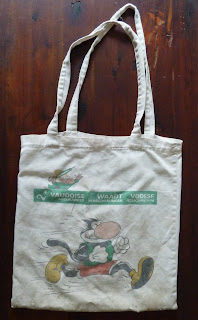 Switzerland, 2001. The Vaud Insurance Company.
 International Society of Anglo-Saxonists, year forgotten. Uh-oh, needs a date with the washing machine.
 Shanghai, 1987. I had at least two of these, four I think; this one has survived 24 years already.
 Switzerland, 2001. The Vaud Insurance Company.
 International Society of Anglo-Saxonists, year forgotten. Uh-oh, needs a date with the washing machine.

24 May 2011
Thank You, Mayor Bloomberg
The Times let slip in an article about a new ban on smoking in New York City parks and beaches that 57 percent of non-smoking New Yorkers have tobacco byproducts in their blood, indicating recent exposure to second-hand smoke.
Call it "nearly two-thirds," call it "more than half," call it what you want -- it's too many. Far too many. Nearly 20 percent of adults have heart disease or asthma (that's according to the Centers for Disease Control, so it ought to be fairly reliable) and shouldn't be exposed to any second-hand smoke. Add in the folks with other lung or circulatory diseases, and we're probably up to a good 25 percent.
I'm still fuming at the guy who objected when I pointed out he was smoking under a no-smoking sign in a New Jersey Transit station, saying it wouldn't hurt me. As it happened, I was recovering from pneumonia at the time -- so yes, actually, it would.
But I hate being put in the position of having to invoke illness, or invisible disability, to get someone to extinguish a cigarette. It shouldn't feel shameful, yet invariably, it does, because of the way our culture frames the ill as culpable, or malingerers -- or both.
Grrrr. Well, I'm grateful to Mayor Bloomberg for all he's done to combat smoking in public places. The ban will be "self-enforcing" according to the Times article; I hope it works.
Call it "nearly two-thirds," call it "more than half," call it what you want -- it's too many. Far too many. Nearly 20 percent of adults have heart disease or asthma (that's according to the Centers for Disease Control, so it ought to be fairly reliable) and shouldn't be exposed to any second-hand smoke. Add in the folks with other lung or circulatory diseases, and we're probably up to a good 25 percent.
I'm still fuming at the guy who objected when I pointed out he was smoking under a no-smoking sign in a New Jersey Transit station, saying it wouldn't hurt me. As it happened, I was recovering from pneumonia at the time -- so yes, actually, it would.
But I hate being put in the position of having to invoke illness, or invisible disability, to get someone to extinguish a cigarette. It shouldn't feel shameful, yet invariably, it does, because of the way our culture frames the ill as culpable, or malingerers -- or both.
Grrrr. Well, I'm grateful to Mayor Bloomberg for all he's done to combat smoking in public places. The ban will be "self-enforcing" according to the Times article; I hope it works.
20 May 2011
Avoiding Plastic
I've been thinking about plastic a lot of the time since February.
Herewith, a pair of lists:
More plastic:
Avoiding the stuff means constant vigilance. The other day I asked The Mate why we switched to liquid laundry detergent; apparently the supermarket in the neighborhood we moved to last summer doesn't carry fragrance-free powder. I'll have to work on that. Now that Tom's of Maine switched from an aluminum tube to plastic, I'm working on tooth powder too.
Herewith, a pair of lists:
More plastic:
- shampoo in a plastic bottle
- liquid laundry detergent
- toothpaste
- cling wrap and plastic sandwich bags
- canned beans
- tampons with a plastic applicator
- bar shampoo
- powdered laundry detergent
- tooth powder
- reusable containers; waxed paper bags
- dry beans, cook 'em yourself
- applicator-less tampons; Diva Cup
Avoiding the stuff means constant vigilance. The other day I asked The Mate why we switched to liquid laundry detergent; apparently the supermarket in the neighborhood we moved to last summer doesn't carry fragrance-free powder. I'll have to work on that. Now that Tom's of Maine switched from an aluminum tube to plastic, I'm working on tooth powder too.
Subscribe to:
Posts (Atom)


 Posts
Posts


